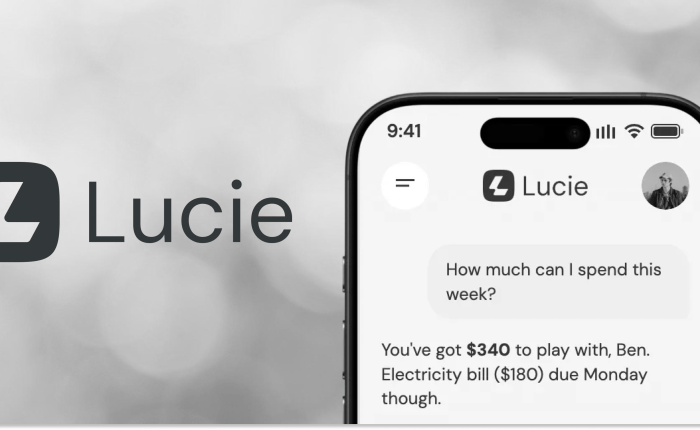
I’m building Lucie Money

I’m building Lucie Money

After years working in banking and fintech, I’ve started building something new. I’ve put together a team and advisory board to make it happen.

Lucie Money is an AI-powered personal finance agent – a new approach to helping people manage their money without the friction of traditional PFM tools.

The gap we’re trying to fill

Australian banking apps have come a long way (I’ve written about that before). But there’s still a fundamental problem: they show you what happened, not what to do about it.

Dashboards and spending breakdowns are useful, but they require you to look, interpret, and decide. Most people don’t have the time or inclination to do that regularly. The mental load of staying across your finances remains high.

What Lucie does

Lucie connects securely to your bank accounts and monitors your finances continuously. Instead of waiting for you to check in, it reaches out when something matters – an unusual transaction, an upcoming bill that might cause a shortfall, a pattern worth knowing about.

When you do have questions, you ask in natural language. Want to set a budget? Ask Lucie. Wondering if you’re on track for a savings goal? Ask Lucie. Trying to compare home loan rates or find a better deal? Ask Lucie. No navigating menus or deciphering charts.

The goal is to give people the benefits of careful financial attention without requiring them to do the attending.

Current status

We’re building the MVP now, targeting launch in Australia later this year. If you’re interested in early access, there’s a waitlist at www.lucie.money.

I’ll share more about the build as we go.

Australian banking apps are better than we think

Australian banking apps are better than we think

Reading articles from The Financial Brand is always a good way to keep abreast of trends in the US banking industry, not least with a recent piece on app functionality (based on a recent industry survey) called “Major Banks’ Mobile Apps Evolve into ‘Payment Central’ for Consumers“.

But reading the article you could be excused for thinking the survey highlights radical new developments in retail banking functionality:

  • “Payments functionality on mobile banking apps keeps expanding, as consumers want to execute more complex transactions.”
  • “Major banks’ consumer mobile apps are becoming home to mobile payment control centers.”

Whereas the truth is that anyone with a passing knowledge of the retail banking space in Australia would recognise that the “more sophisticated tasks” referenced in the survey are really just functions that most Australian banking apps have delivered for years. For example:

Continue reading “Australian banking apps are better than we think”

Finovate Spring 2016 – Day 2 Highlights

Finovate Spring 2016 – Day 2 Highlights

The second day of Finovate Spring 2016 provided over 30 presentations on a range of perspectives across digital on-boarding, roboadvice, data analysis and security.  As with day 1, a common theme seemed evident:  a combination of digital self service + human interaction + artificial intelligence.

I’ve previously written about a selection of Day 1 presenters; here are a few highlights from Day 2.

Continue reading “Finovate Spring 2016 – Day 2 Highlights”

Finovate Spring 2016 – Day 1 Highlights

Finovate Spring 2016 – Day 1 Highlights

I’ve just returned from Finovate’s May 2016 Conference in San Jose, where a clear theme emerged:  a combination of digital self service + human interaction + artificial intelligence.

From an enormous range of 71 presenters (I think one dropped out) here are a few personal highlights from  Day 1.

Continue reading “Finovate Spring 2016 – Day 1 Highlights”