I’m building Lucie Money

I’m building Lucie Money

After years working in banking and fintech, I’ve started building something new. I’ve put together a team and advisory board to make it happen.

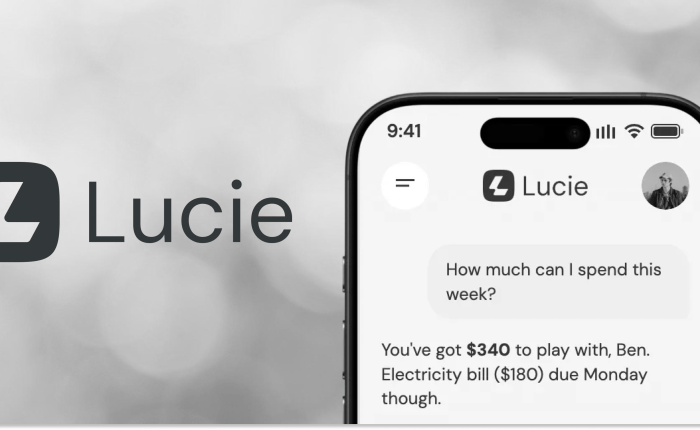
Lucie Money is an AI-powered personal finance agent – a new approach to helping people manage their money without the friction of traditional PFM tools.

The gap we’re trying to fill

Australian banking apps have come a long way (I’ve written about that before). But there’s still a fundamental problem: they show you what happened, not what to do about it.

Dashboards and spending breakdowns are useful, but they require you to look, interpret, and decide. Most people don’t have the time or inclination to do that regularly. The mental load of staying across your finances remains high.

What Lucie does

Lucie connects securely to your bank accounts and monitors your finances continuously. Instead of waiting for you to check in, it reaches out when something matters – an unusual transaction, an upcoming bill that might cause a shortfall, a pattern worth knowing about.

When you do have questions, you ask in natural language. Want to set a budget? Ask Lucie. Wondering if you’re on track for a savings goal? Ask Lucie. Trying to compare home loan rates or find a better deal? Ask Lucie. No navigating menus or deciphering charts.

The goal is to give people the benefits of careful financial attention without requiring them to do the attending.

Current status

We’re building the MVP now, targeting launch in Australia later this year. If you’re interested in early access, there’s a waitlist at www.lucie.money.

I’ll share more about the build as we go.

Australian banking apps are better than we think

Australian banking apps are better than we think

Reading articles from The Financial Brand is always a good way to keep abreast of trends in the US banking industry, not least with a recent piece on app functionality (based on a recent industry survey) called “Major Banks’ Mobile Apps Evolve into ‘Payment Central’ for Consumers“.

But reading the article you could be excused for thinking the survey highlights radical new developments in retail banking functionality:

  • “Payments functionality on mobile banking apps keeps expanding, as consumers want to execute more complex transactions.”
  • “Major banks’ consumer mobile apps are becoming home to mobile payment control centers.”

Whereas the truth is that anyone with a passing knowledge of the retail banking space in Australia would recognise that the “more sophisticated tasks” referenced in the survey are really just functions that most Australian banking apps have delivered for years. For example:

Continue reading “Australian banking apps are better than we think”

Open Banking and the Consumer Data Right

Open Banking and the Consumer Data Right

In May last year, the Commonwealth Government announced that it would introduce an overarching Consumer Data Right (CDR), starting in the banking sector with the phased implementation of ‘Open Banking’ from 1 July 2019.

While the starting dates for the CDR have since changed, the ambition of the program remains unaltered, with the Australian Competition and Consumer Commission (ACCC) already engaged in preliminary discussions to extend the CDR beyond banking to the power and telecommunications industries.

So, what is Open Banking/CDR? And what is its potential impact on Authorised Deposit-taking Institutions (ADIs)?

Continue reading “Open Banking and the Consumer Data Right”

Lego Banking: A modular approach to banking customer experiences

Lego Banking:  A modular approach to banking customer experiences

In July I attended the Microsoft Inspire 2018 conference in Las Vegas.

The event was pretty impressive, not so much because of its size (and, yes, it was huge), but more so because of the clear and consistent strategy that was evident in everything.

And that strategy has direct relevance to the trajectory of banking software: to the way in which product strategists should be envisioning and architecting banking customer experiences (CXs).

Continue reading “Lego Banking: A modular approach to banking customer experiences”

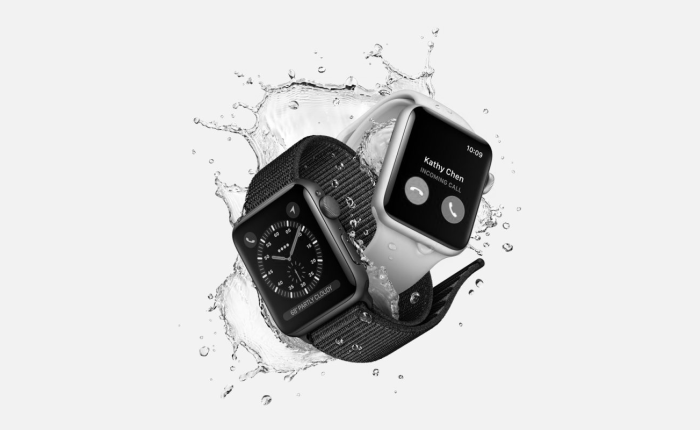
Apple Watch Series 3. A game changer for mobile wallets?

Apple Watch Series 3.  A game changer for mobile wallets?

A little over a year ago I wrote about some of the reasons for consumer dissatisfaction with Apple Pay on Apple Watch.

Last month’s announcement of Apple Watch Series 3 (GPS + Cellular) has the potential to change some of that, so it’s time to revisit the issue. Is Series 3 a game changer for mobile wallets?

Continue reading “Apple Watch Series 3. A game changer for mobile wallets?”

13 ways to conduct UX testing – and why it’s so important

13 ways to conduct UX testing – and why it’s so important

I recently came across a story about an approach to UX testing being used by Wells Fargo which highlights the importance of experimenting with different ways to conduct UX testing.

At one of its downtown San Francisco branches, Wells Fargo has set up an area called ‘Digital Express’.  This section of the branch provides customers with a series of tablets demonstrating proposed new new digital banking features/functions.  Customers can interact with the prototype solutions and provide quick and direct feedback to the bank, thus allowing the Wells Fargo product development team to ‘…test fast failures in a matter of weeks, rather than months or years’.

It’s an excellent example of the different ways in which UX testing can be conducted.

Continue reading “13 ways to conduct UX testing – and why it’s so important”

Finovate Spring 2016 – Day 2 Highlights

Finovate Spring 2016 – Day 2 Highlights

The second day of Finovate Spring 2016 provided over 30 presentations on a range of perspectives across digital on-boarding, roboadvice, data analysis and security.  As with day 1, a common theme seemed evident:  a combination of digital self service + human interaction + artificial intelligence.

I’ve previously written about a selection of Day 1 presenters; here are a few highlights from Day 2.

Continue reading “Finovate Spring 2016 – Day 2 Highlights”

Finovate Spring 2016 – Day 1 Highlights

Finovate Spring 2016 – Day 1 Highlights

I’ve just returned from Finovate’s May 2016 Conference in San Jose, where a clear theme emerged:  a combination of digital self service + human interaction + artificial intelligence.

From an enormous range of 71 presenters (I think one dropped out) here are a few personal highlights from  Day 1.

Continue reading “Finovate Spring 2016 – Day 1 Highlights”

Can Apple Pay help to save Apple Watch?

Can Apple Pay help to save Apple Watch?

Like many people, I’ve previously come to regard the Apple Watch as ugly, inconvenient and pointless.

Initially I awaited its arrival with interest.  I trialed it with enthusiasm to learn how this new bit of hardware might help, and maybe even transform, my life.

But over time I found that I was using it less and less, the usability issues became harder to accommodate and the incessant buzzing on my wrist became more irritating than helpful.

And so, along with many people, I drifted away from its use.  It wasn’t a deliberate decision; more a question of losing interest.  And so for the last six months my Apple Watch has been relegated to the role of test device for app development.

That’s not to say that there aren’t many people who love their Apple Watch. There are plenty of people who love being so intimately aware of incoming phone calls, upcoming meetings, text messages, driving instructions, etc.  And there is a sizable population who like it for its fitness and health benefits.

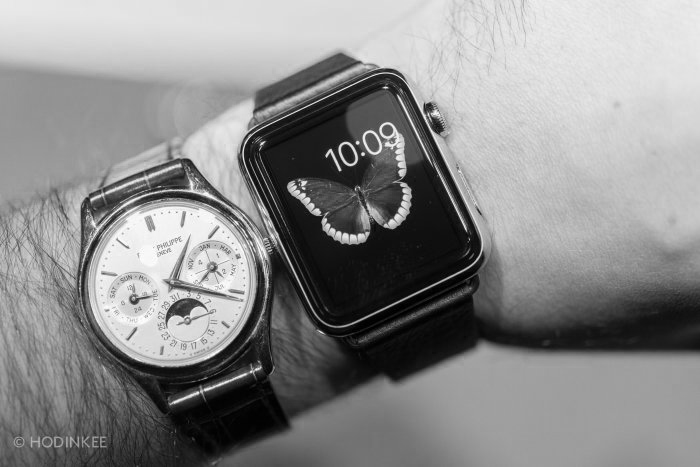
It’s just that I’m not one of them.  I don’t use the fitness monitoring; I’m more irritated than excited by the alerts; and to be honest, I don’t like that it looks less like a a quality time piece and more like a small phone strapped to my wrist.  Call me traditional… but it doesn’t help that I don’t like its appearance.

watchcompare-0000

And I’m not alone – the internet is full of people bagging the device – all of which probably accounts for the watch’s apparent low sales volumes.

However, the other day, ANZ launched Apple Pay in Australia (disclosure:  I’m an ANZ customer) and I tried out Apple Pay, both on the phone and on the watch:  and I think I might be prepared to change my mind.

Continue reading “Can Apple Pay help to save Apple Watch?”

Self-driving cars will change the world – and banking

Self-driving cars will change the world – and banking
These days it seems the news is full of stories about autonomous driving.

The other day I came across the video below.  It shows what can happen when an unprepared person is placed behind the wheel of a self-driving car.  In this case, the car was a Tesla in autopilot mode and the driver was the owner’s mother.

Source:  https://www.youtube.com/watch?v=QVU6ANI059M

The video highlights what can happen when standard expectations confront new modes of behaviour associated with technological innovation.  In this case the disjuncture is hugely discomforting for the lady sitting in a Tesla Model S.

But Tesla is not alone in developing self-driving cars.

Continue reading “Self-driving cars will change the world – and banking”